Opening a bank account should feel simple. Then you hit the ID check screen. You upload documents, answer a few questions, and wait.
That’s KYC, short for Know Your Customer. It’s the process banks use to confirm who you are and understand why you want an account. In plain terms, banks use KYC to protect you and the system from fraud and crimes like money laundering.
In 2026, KYC matters more than ever. Tech makes fakes easier to create, and regulators keep tightening rules around identity and ownership. So banks now combine document checks, database matching, risk scoring, and ongoing monitoring.
This guide explains how banks use KYC to verify customers. You’ll see the core steps, the tools behind the scenes, the US rules banks follow, and what’s changing toward continuous checks.
The Core Steps Banks Take to Verify Your Identity
KYC usually starts before you ever get a card. First, the bank confirms basic identity. Next, it checks risk and purpose. Finally, it may do extra checks for higher-risk cases.
Think of it like a front door with multiple locks. One lock confirms your ID. Another lock checks whether your story matches your profile. And if anything looks off, the bank adds more checks.
Here’s the typical flow banks follow:
- Collect your details
Banks ask for your name, address, date of birth, and government ID. You’ll often upload a driver’s license or passport. - Verify your documents and identity
They check whether the ID looks real (and matches your info). Many banks use AI to scan documents and match your face. - Confirm account purpose and money source
You might answer why you need the account and how you’ll fund it. For example, “salary deposit” or “business revenue.” - Assign a risk level
The bank scores your risk based on things like location, occupation type, account activity plans, and account structure. - Run extra checks for higher-risk customers
This can include screening against PEPs (politically exposed persons) and sanctions lists. - Verify ownership for business accounts
For companies, banks confirm who owns and controls the business (not just who opens the account).
If you want a clear, US-focused walk-through, this 6-step guide to KYC verification is a helpful companion for how banks document their process.
The key benefit for you is consistency. When KYC works well, it also reduces delays. Low-risk customers often move through faster because the bank can verify with less manual work.
Step 1: Collecting and Confirming Basic Details
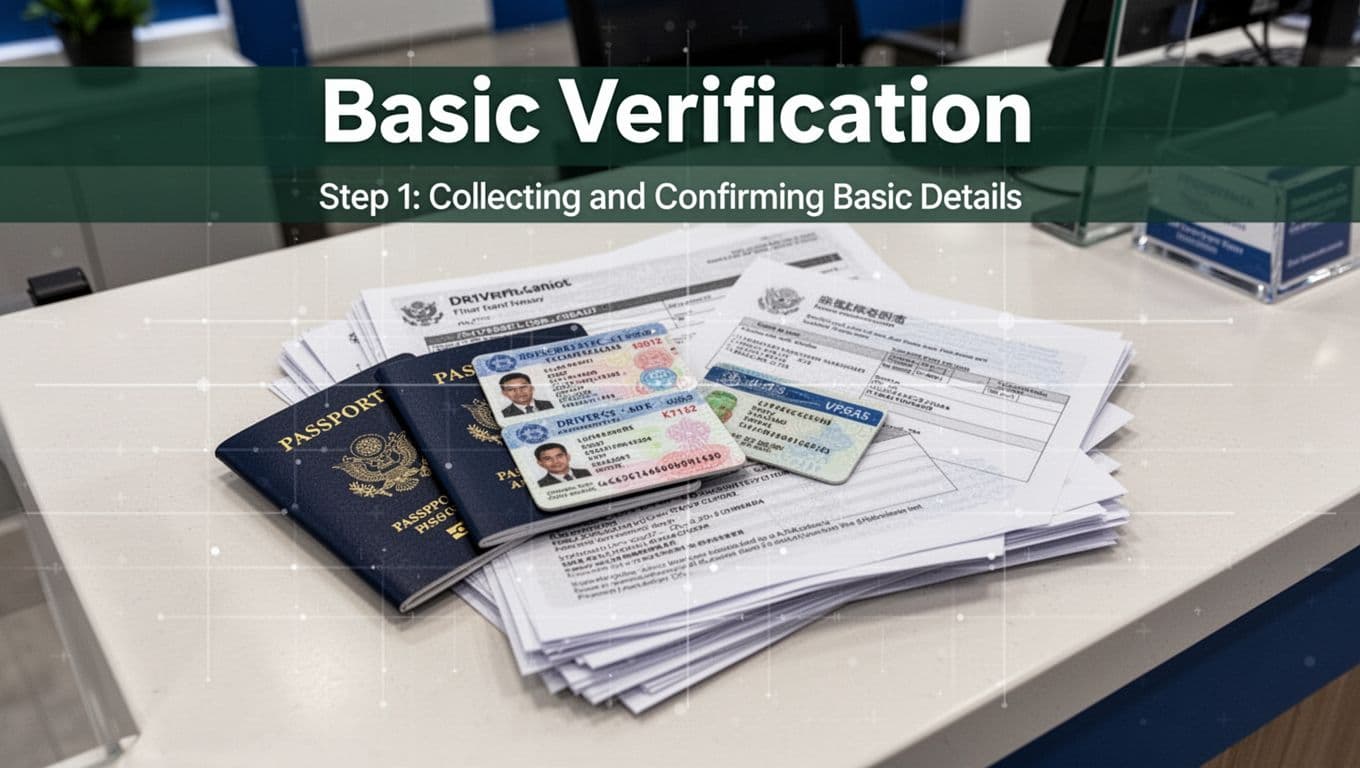
This step is the “show me who you are” part. Banks collect standard fields like your legal name, residential address, and date of birth. Then they ask for a government-issued ID.
In practice, you might upload:
- Driver’s license
- State ID
- Passport
- Visa or other approved documents (for some applicants)
Next, banks cross-check what you provided. For example, they may compare your name and birth date against identity databases. They also check whether the address looks valid and consistent.
Many banks also validate document quality. They look for signs of tampering, expired IDs, or mismatched fields. At the same time, the system checks whether your data format looks right. A wrong date layout or incomplete address can trigger a review.
Speed matters here. You don’t want to wait days to open an account. That’s why banks rely on real-time validation tools and automated checks, especially for common document types.
Still, the goal isn’t to slow you down. It’s to reduce the risk of accepting a stolen identity. Once your basic details pass, the bank can move on to risk scoring.
A quick example helps. Suppose someone tries to open an account with a real ID photo from a stolen file. The bank’s scan checks may flag inconsistencies. If it passes, the face match step usually still adds protection.
Step 2: Digging Deeper for Risk and Ownership
Once a bank confirms your basic identity, it asks a different question: “Is this account behavior likely to be legitimate?”
That’s where risk scoring comes in. Banks combine multiple signals, such as:
- Your stated purpose for the account
- Your expected activity level
- Your location
- The type of job or business you report
- Patterns tied to fraud trends
Then the bank decides whether it needs deeper review. For example, a customer planning large cash movement or complex transfers may trigger enhanced due diligence. In other words, the bank may ask for more proof about your money source or account goals.
For business accounts, ownership checks matter even more. Banks do not want “shell” companies that hide the real controller. So they verify beneficial owners, meaning the real people who own or control the company.
Ownership verification can include:
- Asking for ownership and control details
- Collecting IDs for owners who must be verified
- Screening those owners against relevant lists
- Checking consistency across documents
In early 2026, FinCEN guidance also pushed banks to reduce repeat work when beneficial ownership information is already reliable. That shift aims to cut duplicate checking while still keeping AML rules intact. The result is often less friction for customers once the bank trusts the record.
As you can see, KYC isn’t only about IDs. It’s also about making sure your account story makes sense.
Smart Technologies Powering Modern KYC Checks
Old-style KYC relied heavily on manual review. In 2026, most banks use a mix of automation and human oversight.
Automation helps because identity verification is high volume. Millions of customers need checks every year. So banks use systems to verify documents, compare faces, and spot suspicious patterns quickly.
At a high level, smart KYC tools handle three jobs:
- Check the document looks legitimate
- Match you to the document
- Watch for suspicious signals over time
Banks also monitor your device and session behavior. They may flag if the upload looks staged or if the video capture seems suspicious.
One of the biggest changes is how banks reduce “dead time.” Instead of waiting for a human to review every case, the system does first-pass validation. Then only higher-risk cases go deeper.
AI and Biometrics: Spotting Real People Instantly
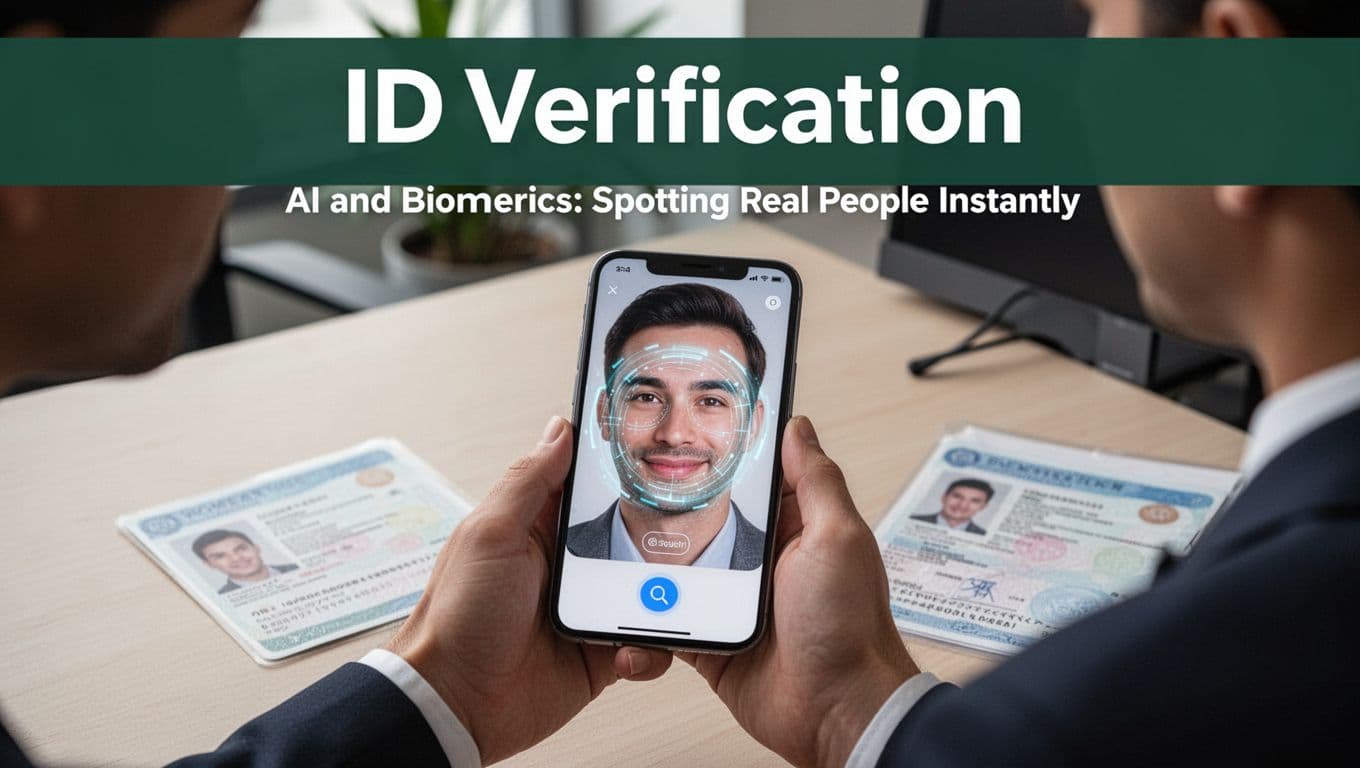
Many banks use biometrics for identity checks, especially face matching. You might take a selfie or short video while uploading your ID.
Then the system compares:
- Your face in the selfie to your ID photo
- The consistency of facial features across frames
- Signs of spoofing (like flat images or simple deepfakes)
Some banks also use liveness detection. This helps prove you’re a real person during capture. It’s similar to phone unlock features, but applied to account onboarding.
Banks still keep humans in the loop for edge cases. If the match confidence is low or the capture looks unusual, a reviewer can request a retry or extra documents.
In addition, AI can spot patterns that humans miss. For example, it may detect repetitive upload errors across many applications, which can point to fraud operations.
If you’re curious how KYC tech is being positioned for the “real-time” part of verification, KYC in banking considerations for 2026 offers a broad view of where banks focus most.
Ongoing Watches: Catching Suspicious Activity
KYC used to feel like a one-time event. You verified once, then moved on.
Now many banks use ongoing monitoring. The system continuously watches for changes in risk. For example, it may flag:
- Sudden account inflows far above your usual pattern
- Rapid transaction spikes
- Unusual geographic activity
- New beneficiaries or counterparties that raise concerns
This is often called perpetual KYC, or pKYC. The main idea is simple. The bank updates risk thinking as your behavior changes.
So instead of waiting years for a periodic review, the system can trigger alerts right away. Then staff can investigate if needed.
Here’s the tradeoff. More monitoring can mean more questions when behavior changes. But for most customers, it also means faster resolution. If the alert triggers because of an unusual transfer, the bank can ask for context while you still have control of the situation.

Regulations That Force Banks to Get KYC Right
Banks don’t run KYC just to be careful. They do it because the law requires it.
In the US, KYC connects to broader anti-money laundering obligations under the Bank Secrecy Act (BSA) framework. That includes rules around identifying customers, understanding beneficial ownership, and monitoring for suspicious activity.
Banks also follow global standards. Many US processes align with international expectations, because criminals don’t follow country borders.
In practical terms, regulations push banks to:
- Verify identity and ownership data
- Keep records of what they checked
- Train staff and document decisions
- Apply risk-based due diligence
Also, regulators keep watching how banks handle high-risk customers. That’s why many banks spend on compliance remediation, not just onboarding.
Here’s an important point for readers: KYC isn’t meant to punish regular customers. It’s a system to prevent criminals from hiding behind stolen identities and fake companies.
If your KYC request feels strict, it’s usually because the bank needs proof for audits and legal obligations.
Banks that fail these expectations can face enforcement actions. Penalties can include fines, orders to improve programs, and restrictions on certain activities. Even when enforcement isn’t about a specific ID check, weak compliance systems can still lead to major consequences.
Big US Laws and Global Standards
A major piece of the US framework is the CDD Final Rule from FinCEN. It focuses on customer due diligence and beneficial ownership requirements for certain covered financial institutions. In plain English, it tells banks to identify and verify the people behind legal entity customers. It’s also meant to improve transparency and reduce abuse of companies for illicit activity.
For direct context on these requirements, see FinCEN’s CDD Final Rule.
Beyond that, banks also deal with beneficial ownership reporting under the Corporate Transparency Act (CTA) ecosystem. That stream of rules affects how legal entities provide ownership information over time. As a result, banks increasingly treat ownership data as a living record, not a one-time form.
So what should you expect as a customer? More clarity on what documents are acceptable, and more consistency across onboarding and periodic reviews. You may also see fewer repeated questions if the bank already has verified ownership records and your risk level doesn’t change.
Why KYC Is Evolving and What It Means for You
KYC is moving away from “check the box” verification. Instead, banks aim for continuous monitoring and smarter refreshes of customer risk data.
That means you might see:
- Faster onboarding for low-risk customers
- Extra verification when your profile changes
- Requests for updated documents sooner, if needed
For example, if you change jobs, move to a new state, or start sending larger transfer amounts, the bank may review your risk again. That’s not personal. It’s how risk systems respond to new signals.
The positive side is reliability. When KYC runs continuously, it can catch mistakes earlier. It also reduces the odds that a stale record blocks you later.
Finally, banks keep working to reduce friction. The direction in 2026 is clear: better automation, fewer repeat checks, and stronger safeguards when risk is higher.
KYC may never feel “fun,” but it should feel predictable. And when it does, you spend less time proving you’re you.
Conclusion
So, how do banks use KYC to verify customers? They collect your details, verify documents, match your identity, and then score risk using your account purpose and behavior. For higher-risk cases, they add checks like PEP and sanctions screening. For business accounts, they verify beneficial ownership so real controllers don’t hide behind shell companies.
Just as important, modern KYC doesn’t stop at onboarding. Banks use ongoing monitoring to catch suspicious shifts early, so you can resolve issues faster.
If you’ve recently opened an account, share your experience in the comments. How long did the KYC step take, and what did the bank ask for?